
Inside ForgeTales
Characters with real depth
Flat characters sink good stories. ForgeTales gives you curated character sheets that go far beyond name and age: backstories, habits, traumas, MBTI personalities, plus a relationship map that keeps every alliance, rivalry and secret in view, even when your cast grows into the dozens.
Why good characters carry good stories
Readers will forgive a familiar plot, a slow chapter, even a shaky magic system. What they rarely forgive is a hollow protagonist. Plot is what happens; characters are why any of it matters. They are the door through which a reader enters your world, and the reason they stay.
Worldbuilders know this trap well: months spent perfecting kingdoms, currencies and pantheons, while the people who live in them stay as names on a list. The fix is not more lore. It is people whose wounds and wants collide with the world you built, because that collision is where stories come from.


How to build a character that breathes
Start with the wound and the want. What happened to this person before page one, and what do they now desire because of it? A backstory matters only when it presses on the present: the best ones read like an unpaid debt.
Then give them contradictions. A protagonist who is stoic and reckless, intelligent and ambitious beyond his judgment, is already generating scenes; a virtuous list of adjectives is not. The things a character would never admit out loud are usually the engine of their best chapters.
Finally, place them in the web. Nobody exists alone: characters are shaped by family, rivals, debts, old loves and older enemies. A cast is not a collection of individuals: it is a system of pressures, and your job is to know where each thread pulls.


Your whole cast, in one registry
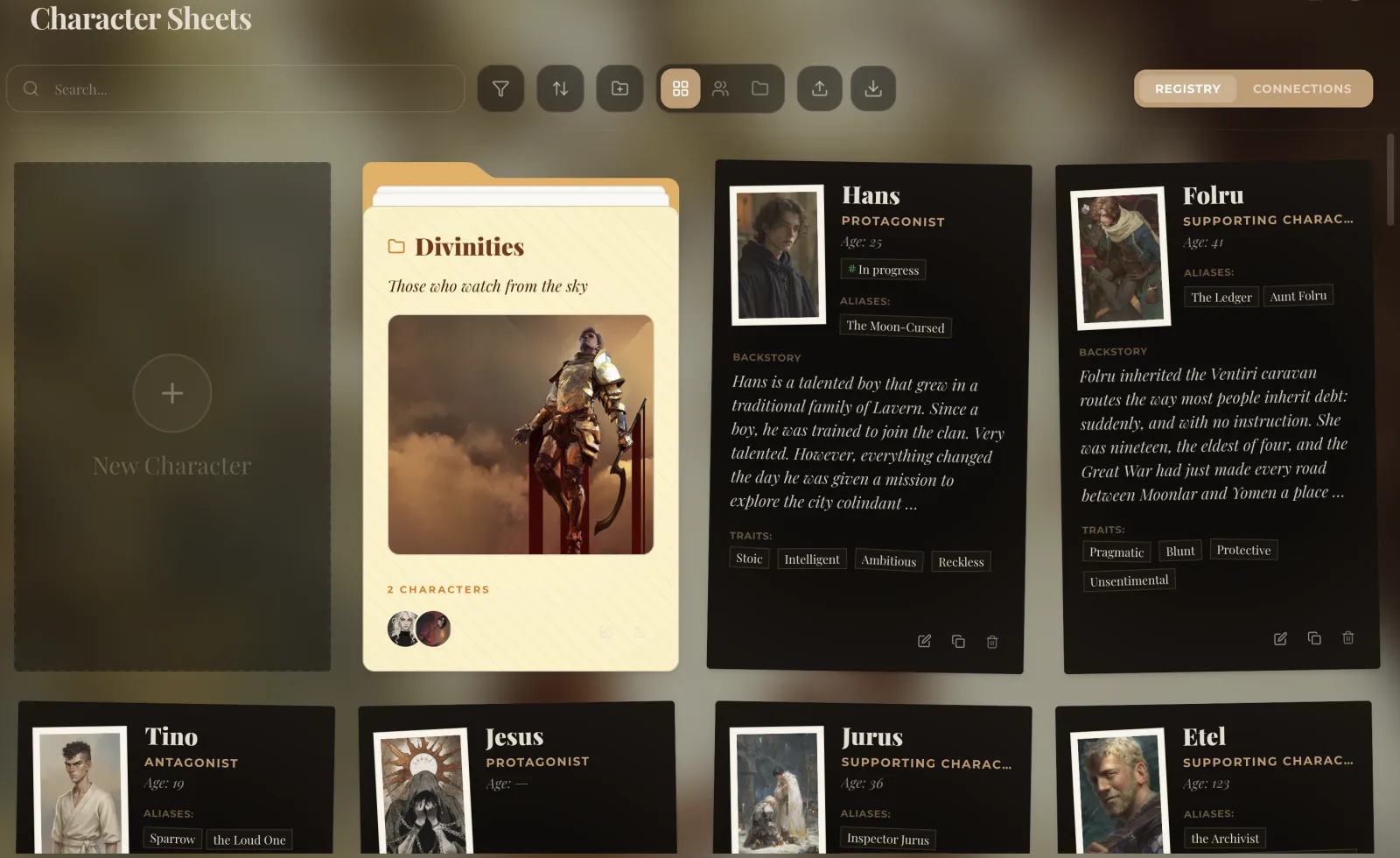
In ForgeTales, every character gets a card in a visual registry: portrait, role (protagonist, antagonist, supporting), age, aliases, traits and a glimpse of their backstory, all readable at a glance. Group them into folders by family, faction or divine order, and the shelf stays tidy no matter how ambitious the saga.
Search, filters and tags like 'in progress' keep even a sixty-name cast navigable. When book three needs that innkeeper you sketched two years ago, she is one search away, portrait, aliases and all.


A sheet that adapts to your character, not the other way around
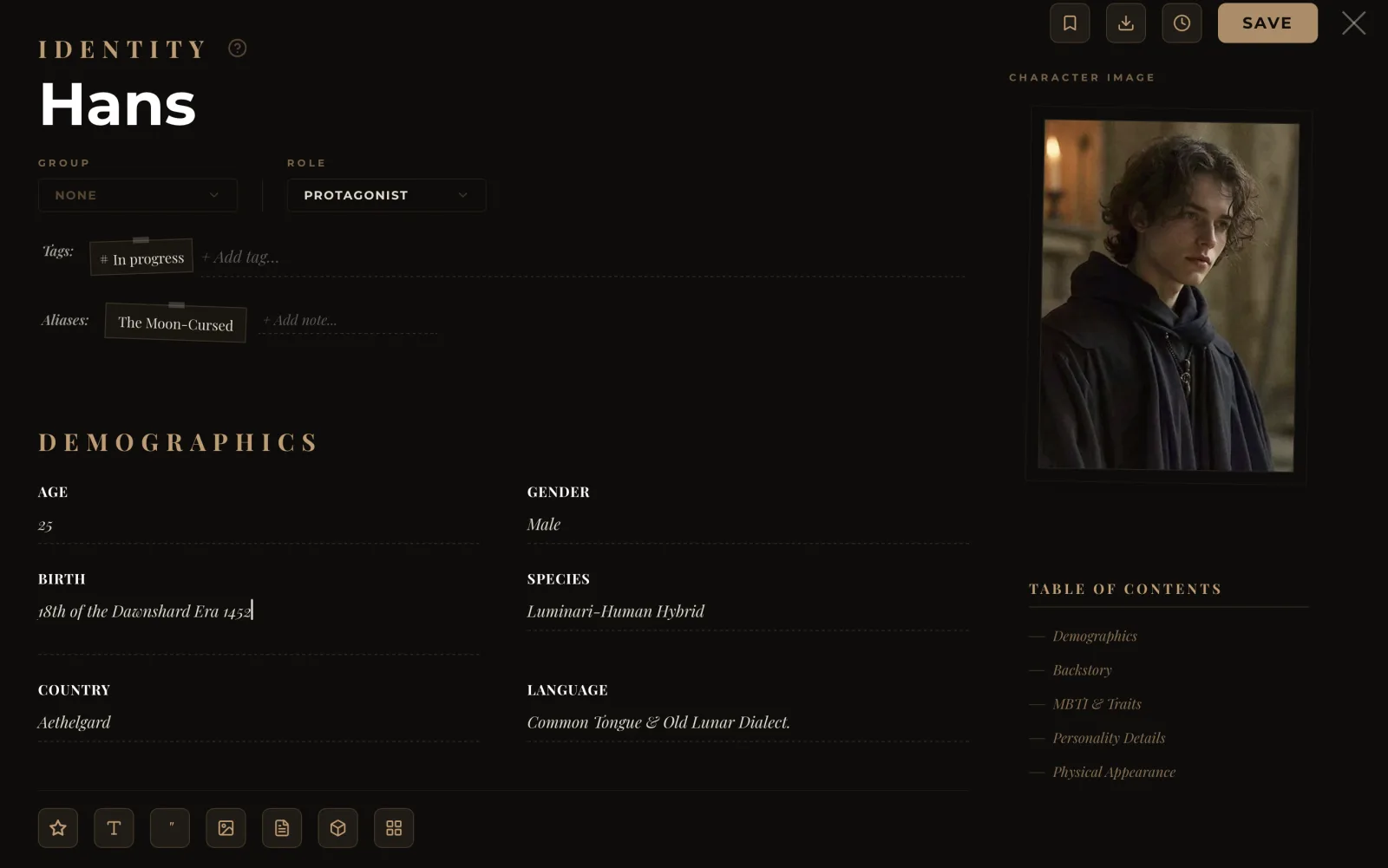
Open a character sheet and a structure unfolds that already covers the essentials: demographics (age, gender, birth, species, country, languages), backstory, MBTI and traits, personality (archetype, inner conflict, goal, trauma, obsession, strengths and weaknesses) and a physical appearance that goes all the way down to voice, bearing, tics and scent.
From there, the sheet is yours. Every section is a block you can rename, move, widen, place beside another or delete. Add the ones you're missing: long text, custom fields, a quote that defines their voice, a table, an image, a reference PDF, or a stat block drawn as a radar chart. If your magic system demands a section for 'broken oaths', you create it, and that's that.
When you land on the structure that works for your characters, save it as a template and reuse it across the rest of the cast. Edit the template later and you'll still be starting from your own standard, nobody else's.
Relationships and family trees
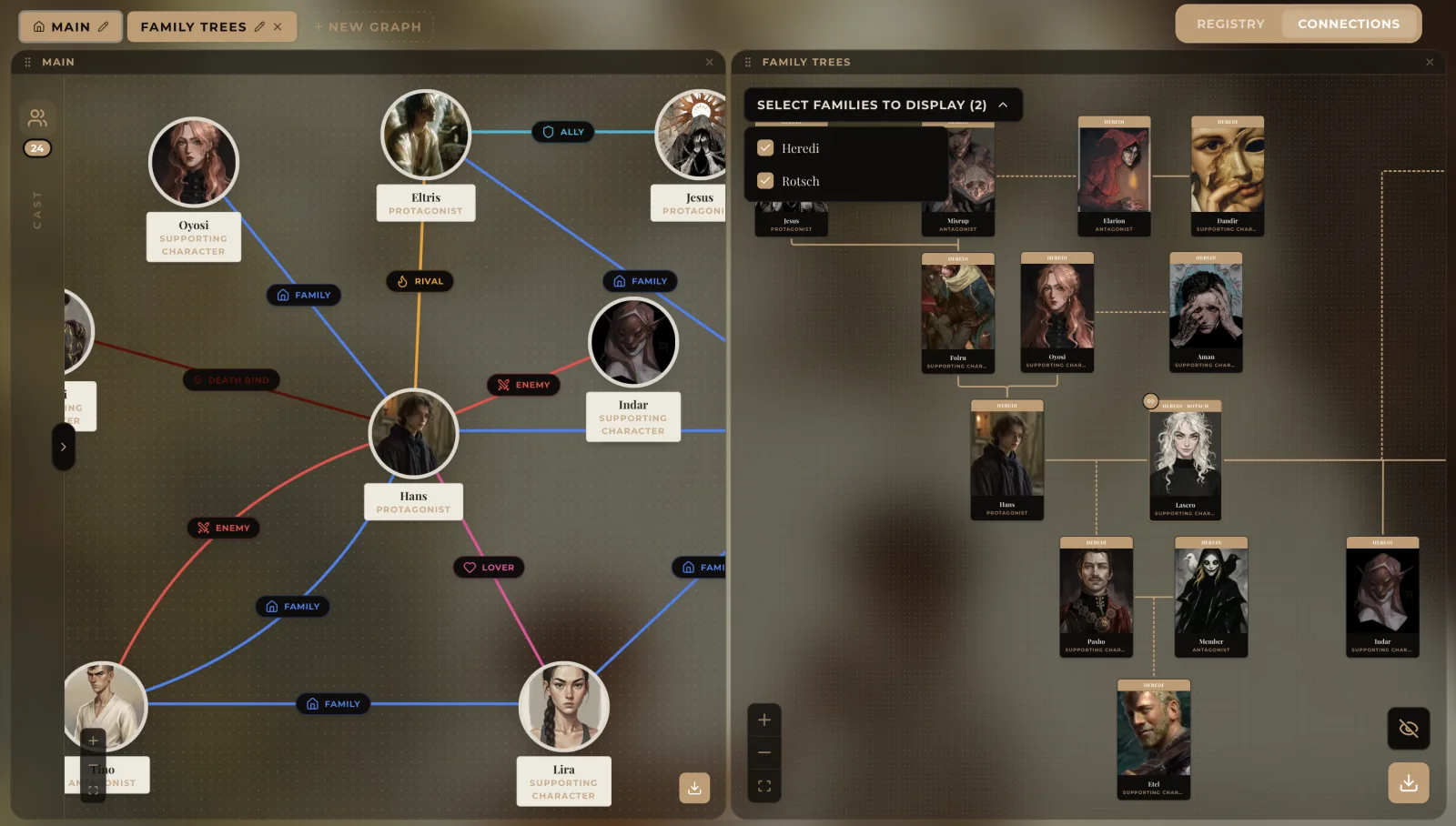
This is where the cast becomes something bigger. The relationship graph draws every bond as a living, color-coded map, and it even distinguishes bonds that aren't symmetrical: a mentor points to their student with an arrow, because that relationship doesn't mean the same thing in both directions. Need a bond that isn't on the list? Create your own relationship type, with its own color and icon.
Family trees get their own view: whole houses laid out side by side, generation by generation. When two bloodlines cross in book four, the genealogy is already drawn. No contradictions, no forgotten cousins.
What you can do with it
Sheets that ask the right questions
Curated templates prompt you for what makes a character breathe: their wounds, their habits, the things they would never admit. And when your story needs its own structure, build fully custom sheets with exactly the fields you want.
A living map of relationships
Connect characters to each other (family, factions, feuds) and see the whole web at a glance. When a saga spans decades and dozens of names, the map remembers so you don't have to.
Woven into the rest of your world
Characters aren't isolated files. Attach them to timeline events, mention them in wiki articles, and keep them beside you while you write in Atelier.
Frequently asked questions
- Can I customize the character sheets?
- Yes. Beyond the curated templates, you can build fully custom character sheets with exactly the fields your story needs. MBTI personality typing is there if you find it useful, invisible if you don't.
- How many characters can I create?
- The free plan includes room for 15 characters in one world, enough to properly try the workflow. The one-time Founder purchase unlocks unlimited characters, forever.
- Is my character work private?
- Completely. ForgeTales runs offline on your desktop and your characters are stored locally on your device. Nothing is uploaded, and nothing is used to train AI.